
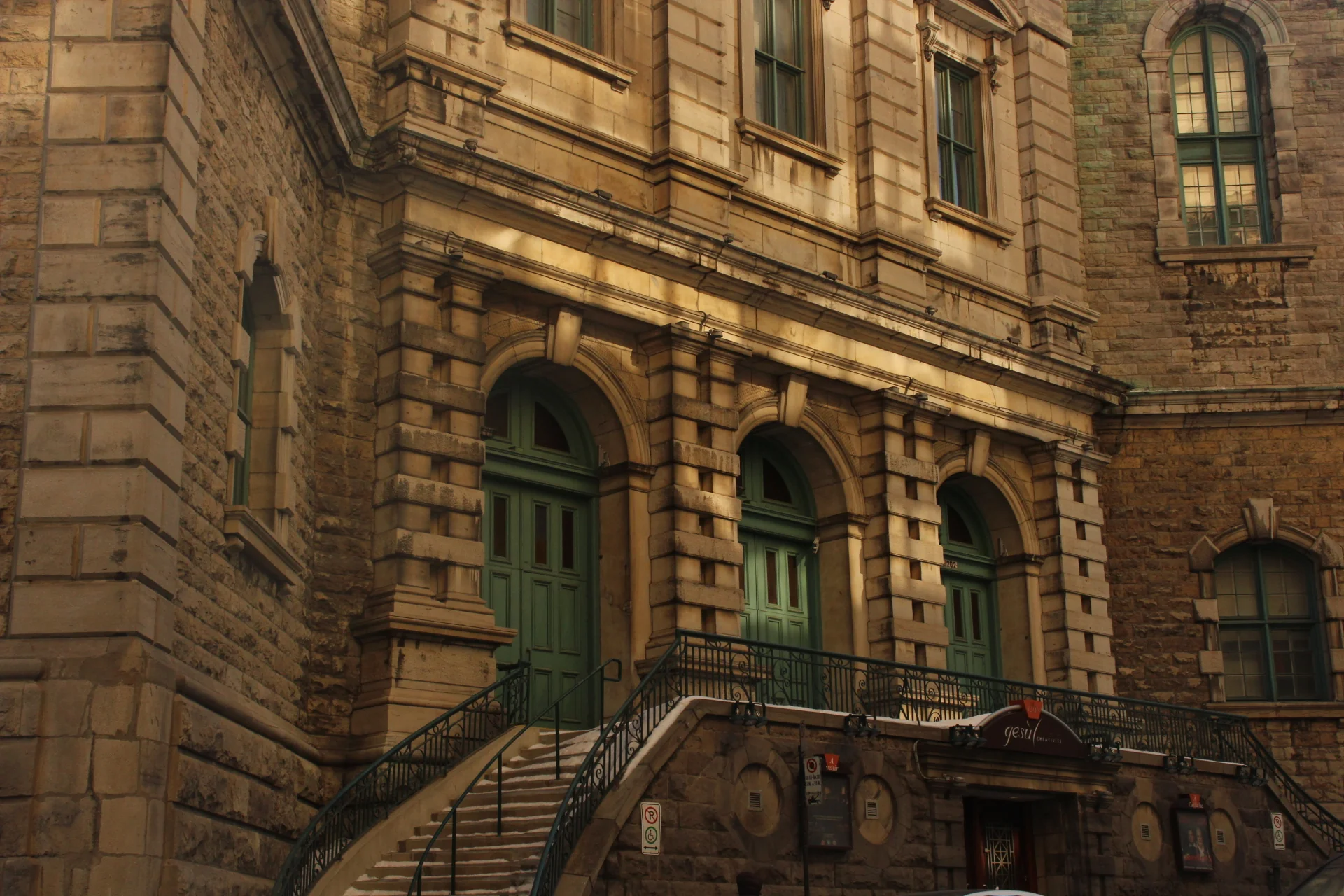
The student with a limited budget and the person who actually grew up with old money have arrived at the same wardrobe from opposite directions. One buys less because they have to. The other has simply never seen a reason to buy more. Both wardrobes look the same: considered, minimal, nothing recent, nothing that calls attention to itself.
The mistake most people make with this style is treating it as an acquisition problem. Old money is built around restraint, not spending. The pieces that carry it are almost certainly already in your wardrobe.
The aesthetic that appears to cost the most is built entirely around the decision to stop buying.
Stripped back, old money is a restricted palette: cream, white, ivory, navy, camel, black, grey, tan - used almost exclusively. It runs on silhouettes that predate trends and on natural (or natural-looking) fabric. Nothing synthetic that catches light in a way that registers as cheap. The complete absence of visible branding matters too, because old money assumes the person wearing it has nothing to prove.
If something was bought specifically to look expensive, it's already working against the aesthetic. The same goes for visible logos and anything that reads as trend-specific. Nothing in the outfit should be announcing itself.
The five pieces
Not five things to wear at once. Five things that, if you own a version of all of them, give you the full vocabulary of old money.
- A white or cream top. Button-down, knit, or fitted tee. Colour does more than silhouette here. White or cream against a neutral bottom is the single most reliable move in this palette, and almost everyone already owns one in some form.
- A tailored or wide-leg trouser in a neutral. Black, camel, grey, or tan. The trouser carries a degree of consideration that jeans don't: it reads as a deliberate choice. Dark straight-leg jeans work if the trouser isn't there.
- A flat shoe with a proper sole. The loafer is the obvious read, but a simple leather flat, a structured ballet flat, or a clean boot all register the same way. An athletic sole or a platform breaks the whole thing; anything that adds visual noise at the base of the outfit works against the silence above it.
- One layer. Something in camel, navy, or black worn over the top. A blazer, a cardigan, a trench coat. The layer is what turns neutral clothes into a considered outfit.
- One simple accessory. A thin belt, a structured bag, a simple watch, a small stud. One or two things that signal attention. Every accessory added after this starts to take something away.
If you own a version of all five, you already have everything the aesthetic requires.
Three ways to put it together
These outfits all draw from the same framework above.
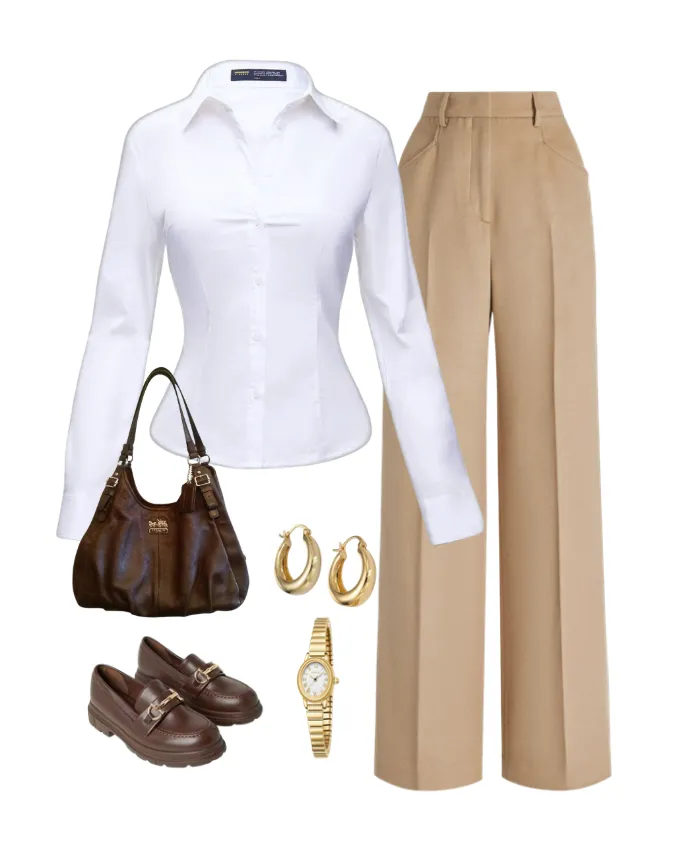
White button-down, wide-leg camel trouser, loafer, gold hoops and watch. White and camel share the same undertone, so the palette resolves itself without needing anything else.
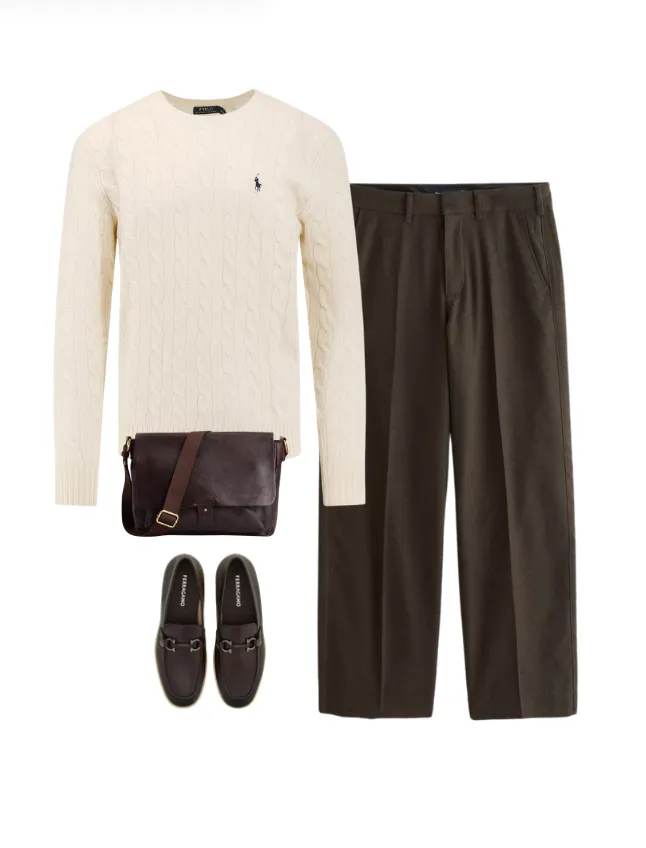
Cream cable knit, dark wide trouser, loafer, structured bag. The cable knit has enough texture that colour contrast isn't doing any work, and the outfit is more interesting for it.
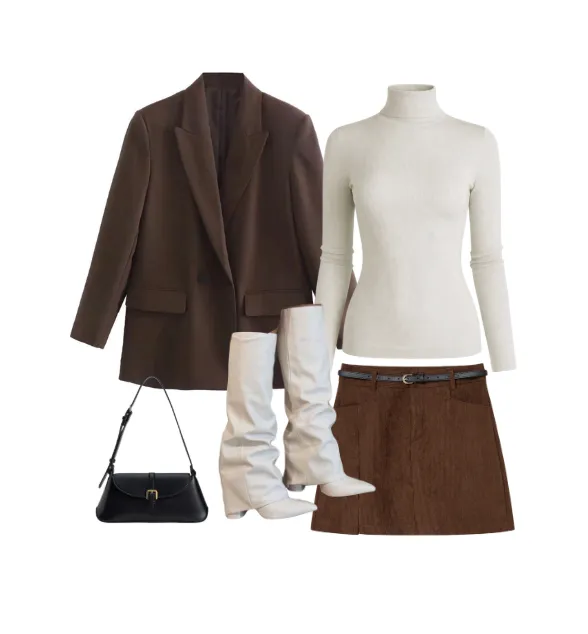
Cream turtleneck under an oversized dark blazer, brown mini skirt, tall boots, structured bag. The rule with anything oversized: one volume piece, everything layered underneath fitted.
The student budget reality
The best source for these pieces is not a department store, and it is definitely not the high-street brands currently selling "quiet luxury" at $150 a piece. It is a thrift store or a secondhand platform. Older clothes (pre-2010, certainly pre-2015) were cut with the exact silhouettes this aesthetic runs on: the wide trouser, the structured blazer, the classic loafer. They were made before fast fashion compressed everything toward the same synthetic cut, which means they carry the quality-of-construction signal that newer budget pieces are actively trying to fake.
Proportion and fit matter here, honestly more than in any other aesthetic. A secondhand blazer that sits correctly on the shoulder reads as expensive. One that doesn't, regardless of what you paid for it, looks borrowed. When you're shopping for this aesthetic, try everything on. The fit of your clothes is doing most of the work.
You've been building this wardrobe for years. The clothes that are worn, washed, and accumulated gradually rather than bought in a single trip. You are already most of the way to this aesthetic.
oro is built to show you which outfits are already sitting in your wardrobe: the combinations you've never thought to put together. The pieces you've had for three years are carrying more than you think.
- oro